
Epoxy Cove Base: What It Is, Where It’s Used, and Why It Matters
Walk into any plant, kitchen, or lab and watch where the problems actually start. It’s rarely the middle of the floor.
Table of Contents
It’s the corner where the floor meets the wall.
Water collects there. Food residue settles there. Cleaning chemicals pool there. Debris builds up there. A standard 90-degree floor-to-wall joint, especially when finished with glued-on rubber or vinyl wall base, starts to peel, separate, or open up a seam that no amount of scrubbing can fully clean.
The flooring detail designed to solve that problem is an epoxy cove base. In the right facility, it’s not a finishing touch. It’s a working part of the sanitation plan.
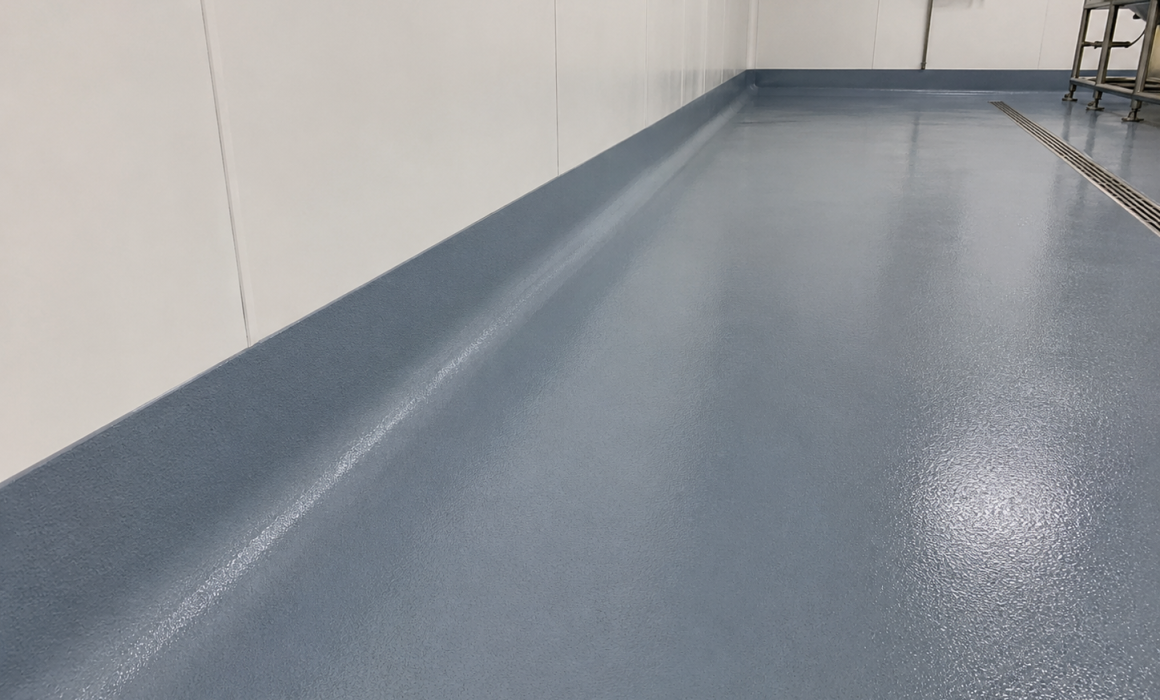
An epoxy cove base turns that sharp inside corner into a seamless, resinous curve or angle that runs from the floor up the wall. No seam, no adhesive line, and fewer gaps where moisture and residue can collect.
If your facility deals with washdowns, sanitation audits, constant scrubbing, or industrial abuse, cove base deserves a seat at the table when the flooring system is being designed, not a decision made after the fact.
What Is Epoxy Cove Base?
Epoxy cove base is a seamless, resinous base installed at the exact point where the floor meets the wall, made of epoxy mortar, urethane cement, or another compatible resinous material as part of the flooring system itself, not bolted on afterward.
Picture the corner rounded off or angled instead of squared – that’s the cove. It closes off the hard inside corner where dirt, moisture, chemicals, and residue would otherwise collect and sit.
The distinction that matters: rubber or vinyl wall base gets glued to the wall after the floor is already down. Epoxy cove base is troweled and cured into the flooring system as one continuous piece. That difference is exactly why one holds up in a wet, sanitary, heavy-use room, and the other eventually doesn’t.
Where Is Epoxy Cove Base Used?
Anywhere cleanability, moisture, and durability aren’t optional, this detail shows up:
- Food and beverage processing facilities
- Commercial kitchens
- Dishwashing areas
- Laboratories
- Cleanrooms
- Pharmaceutical facilities
- Hospitals and healthcare spaces
- Veterinary facilities
- Restrooms and locker rooms
- Washdown areas
- Manufacturing plants
- Chemical processing areas
- Packaging areas
- Industrial production spaces
In every one of these spaces, the wall line isn’t decoration; it’s part of how the floor performs under water, chemicals, impact, and constant sanitation. If any of that applies to your facility, cove base earns a real evaluation, not an afterthought.
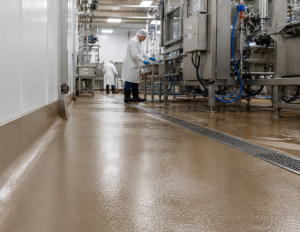
Wet and frequently cleaned spaces, including commercial kitchens and food processing areas, often benefit from seamless floor-to-wall detailing.
Why Epoxy Cove Base Matters
The middle of the floor gets all the attention because that’s where the traffic and the wear are easy to see. The edge is where the real damage quietly happens.
Here’s a common pattern: a dish room runs three washdowns a shift. The rubber base along the back wall starts lifting at the seams within a year. Water gets behind it. Now there’s a hidden pocket of moisture and bacteria-friendly buildup behind a wall base that looks fine from three feet away until the health inspector gets closer, or the smell does.
Epoxy cove base is built to prevent that exact failure. It doesn’t just look cleaner on day one; it stays cleanable after thousands of cleaning cycles, chemical exposures, and impacts. That’s the entire point.
- Improves cleanability at the floor-to-wall joint
- Removes the hard-to-clean corner
- Limits where moisture and debris can collect
- Protects the lower wall from impact and chemical exposure
- Strengthens sanitation and maintenance programs
- Performs as one integrated system with the floor, not a separate part
When Should You Consider Epoxy Cove Base?
If any of these describe your space, cove base belongs in the conversation before the flooring system is finalized:
- Floors are washed down or wet-cleaned regularly
- Food, liquids, chemicals, or residue can reach the wall line
- Sanitation and cleanability are non-negotiable
- Rubber or vinyl base has peeled or trapped moisture before
- The lower wall needs protection from impact or exposure
- The floor is already part of a seamless resinous system
Dry offices, light-duty retail, and low-traffic spaces without washdowns generally don’t need it — a standard wall base does the job. But in food processing, commercial kitchens, labs, cleanrooms, healthcare, and industrial floors, skipping cove base is one of the more common and expensive mistakes we see in flooring specs.
Epoxy Cove Base vs. Rubber or Vinyl Wall Base
Rubber and vinyl wall base work fine in offices, schools, retail, and other dry, light-commercial spaces. They look finished and cost less upfront.
They just weren’t built for water, chemicals, or daily scrubbing. Because rubber and vinyl base is glued on after the floor is installed, every seam, edge, and adhesive line is a potential entry point for moisture — and once water gets behind it, peeling and separation are just a matter of time.
Epoxy cove base skips that failure mode entirely because it’s part of the resinous flooring system, not an add-on:
- Seamless floor-to-wall protection with no adhesive lines
- Holds up under frequent cleaning and sanitation cycles
- Better moisture resistance where rubber and vinyl fall short
- Full compatibility with epoxy or urethane cement flooring
For a dry hallway, rubber base is a reasonable, budget-friendly call. For a washdown room, commercial kitchen, lab, or food-processing floor, an epoxy cove base is the system built for the job — not the one that happens to be cheaper to install.
Common Types of Epoxy Cove Base
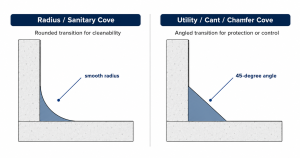
Radius cove creates a rounded sanitary transition, while utility or cant cove creates an angled transition for wall-line protection or moisture control.
There are two profiles used across almost every resinous flooring system: radius cove and utility cove. Picking the wrong one is a common and avoidable spec mistake.
Radius Cove Base
Radius cove, also called sanitary cove base, rounds off the transition, typically with a radius between 3/4 inch and 2 inches, depending on the cleaning process and equipment in the space. The rounded shape is what eliminates the hard inside corner where moisture, debris, food residue, or cleaning solution would otherwise collect.
This is the profile you’ll find in food processing plants, commercial kitchens, dishwashing areas, labs, cleanrooms, healthcare spaces, and washdown rooms — anywhere cleanability drives the decision.
Utility Cove Base
Utility cove, also called a cant or chamfer cove, angles the transition rather than rounding it. It’s the right call when the priority is wall-line protection, moisture control, or slope, and a fully rounded sanitary profile isn’t strictly required.
The right choice between the two comes down to the facility, the cleaning process, the substrate, and the exposure conditions, not personal preference.
Installation Details That Affect Performance
The right material still fails if the surface underneath it isn’t ready, or if the cove isn’t properly integrated into the rest of the flooring system. The details that actually determine whether a cove base lasts:
- Substrate condition and surface preparation
- Moisture or contamination in the slab
- Primer selection
- Cove profile and height (commonly 4 to 6 inches, sometimes higher in heavy-splash zones)
- Aggregate loading and installation sequence
- Topcoat compatibility
In most systems, the cove goes in before the floor coating — not after. That sequence lets the topcoat run continuously over both the cove and the floor, sealing them into a single integrated surface rather than two separate pieces that meet at a seam.
Typical epoxy cove base installation sequence:
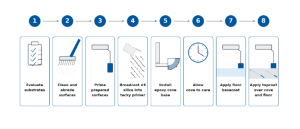
Confirm system-specific requirements before installation.
Common Mistakes to Avoid
Most cove base failures trace back to one of a handful of decisions made early, often before anyone realized cove base was a decision at all:
- Using rubber or vinyl base in a wet or sanitary space
- Picking a cove profile without checking it against the actual cleaning procedure
- Installing over a weak, loose, or contaminated substrate
- Ignoring moisture issues in the slab
- Mismatching the cove base to the main floor system
- Installing the cove after the floor coating when the sequence calls for cove first
- Setting cove height without accounting for washdowns or equipment
None of these show up on day one. They show up eighteen months in, as a peeling edge, a lingering odor, or a corner that fails the next sanitation audit, which is exactly why it’s cheaper to get this right the first time than to fix it later.
How Epoxy Cove Base Supports Cleaning and Maintenance
Cleaning crews spend most of their attention on open floor space, which makes sense — it’s the biggest surface and the most visible. The wall line is smaller, but it’s often the harder area to actually keep clean.
A standard 90-degree joint collects residue in a place a mop or squeegee can’t fully reach. A peeling wall base traps moisture behind it, out of sight. A poorly detailed edge becomes a recurring item on every maintenance list. Epoxy cove base removes that failure point by giving cleaning crews a smooth, continuous surface to work with no corner, no seam, nowhere to hide.
That holds up across wet cleaning, hose-downs, scrubbing equipment, sanitizing chemicals, and food-safe cleaning procedures — the exact conditions that wear down rubber and vinyl-based materials.
For broader maintenance guidance, see Thermal-Chem’s epoxy floor cleaning guide.
Additional Considerations for Regulated Facilities
Some facilities have sanitation, safety, or regulatory obligations that directly shape flooring decisions. For food-related environments, the FDA Food Code is the relevant reference point. For walking-working surface conditions, cleaning practices, moisture, and slip resistance, see OSHA walking-working surfaces.
Epoxy cove base alone doesn’t make a facility compliant. But installed correctly, it becomes one working part of a larger sanitation and maintenance strategy, not a substitute for one.
Looking for Technical Cove Base Details?
This article covers what epoxy cove base is and why it matters. For the installation-focused deep dive, see the companion guide: Epoxy Cove Base Installation Guide. It walks through radius cove, utility cove, acceptable substrates, priming, silica broadcast, aggregate loading, and Thermal-Chem’s 726-CV Cove Kit coverage.
Frequently Asked Questions About Epoxy Cove Base
What is an epoxy cove base?
An epoxy cove base is a seamless, resinous transition installed where the floor meets the wall, creating a durable, cleanable connection between the floor and the vertical surface rather than a hard 90-degree seam.
What is epoxy cove base used for?
It improves cleanability, protects wall surfaces, removes hard-to-clean corners, and adds moisture resistance in commercial and industrial flooring systems.
Where is epoxy cove base commonly used?
Food processing facilities, commercial kitchens, dishwashing areas, laboratories, cleanrooms, healthcare spaces, restrooms, washdown areas, and industrial facilities.
Is epoxy cove base better than rubber wall base?
For wet, sanitary, or industrial spaces, yes — because it’s built into the resinous flooring system rather than glued on afterward. Rubber or vinyl base can still work fine in dry, light-duty areas, but it’s prone to peeling, separating, or seaming in more demanding environments.
What is the difference between radius cove and utility cove?
Radius cove creates a smooth, rounded transition suited to sanitary, cleanable environments. Utility cove (also called cant or chamfer cove) creates an angled transition, typically chosen for wall-line protection or moisture control rather than sanitary rounding.
Is epoxy cove base required in food processing facilities?
Requirements depend on the facility, local code, sanitation program, and flooring spec. It’s not universally mandated, but it’s commonly used in food processing because it directly supports cleanability and removes hard-to-clean corners.
Can epoxy cove base be used with urethane cement flooring?
Yes, as long as the cove base is compatible with the main flooring system. In hot, wet, or heavily cleaned environments, a urethane cement cove base is often the better match.
Should cove base be installed before the floor coating?
In most resinous flooring systems, yes. Installing the cove first allows the topcoat to run continuously over both the cove and the floor, creating a single integrated, sealed surface rather than two separate pieces.
Choosing the Right Cove Base System
Epoxy cove base is a small detail with an outsized effect on how a flooring system actually performs once the ribbon-cutting is over and the daily grind starts.
When the wall line takes on moisture, cleaning chemicals, food residue, impact, or constant sanitation, the floor-to-wall transition isn’t a detail to finalize at the last minute — it’s a decision that shapes how the whole floor holds up for years.
The right system depends on substrate, environment, cleaning procedures, traffic, chemical exposure, cove profile, and long-term performance, not a single default answer.
Thermal-Chem manufactures high-performance resinous flooring systems for commercial and industrial environments, including epoxy and urethane cement systems built for demanding applications. Explore Thermal-Chem products or contact the team for project-specific guidance.